Wednesday, October 7, 2026
UBC's Distributed Medical Education model: training doctors where B.C. needs them most 🩺
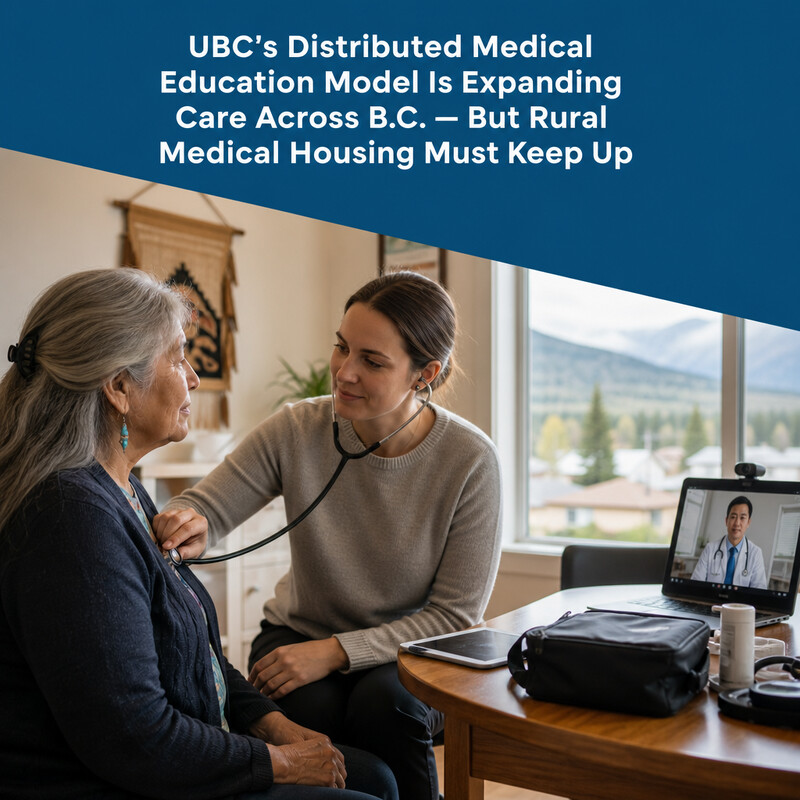
The University of British Columbia Faculty of Medicine has built one of Canada's most important province-wide medical education networks. Instead of training future physicians only in Vancouver, UBC's Distributed Medical Education model places students, residents, and clinical learners across British Columbia — including small, rural, remote, and northern communities where health-care needs can be especially acute.
This model is powerful because it connects medical education directly to community care. Students learn in university classrooms, regional hospitals, community clinics, and rural health settings. They build relationships with local physicians, patients, Indigenous communities, and health authorities. Just as importantly, many learners discover communities where they may later choose to practise.
But there is a practical challenge that can no longer be treated as secondary: medical learners need safe, furnished, flexible housing near hospitals and clinics. In rural and regional B.C., that housing is often difficult to find.
The four UBC MD regional sites
UBC's MD Undergraduate Program accepts 288 students each year and distributes training through four regional sites. Students follow the same curriculum and graduate with the same UBC MD degree, whether they are based in Vancouver, Victoria, Kelowna, or Prince George. The four regional sites include 32 students in the Island Medical Program at the University of Victoria, 32 students in the Southern Medical Program at UBC Okanagan in Kelowna, 32 students in the Northern Medical Program at the University of Northern British Columbia in Prince George, and 192 students in the Vancouver Fraser Medical Program at UBC's Point Grey campus in Vancouver .
- Island Medical Program (IMP): University of Victoria, Vancouver Island.
- Southern Medical Program (SMP): UBC Okanagan campus, Kelowna.
- Northern Medical Program (NMP): University of Northern British Columbia, Prince George.
- Vancouver Fraser Medical Program (VFMP): UBC Point Grey campus, Vancouver.
For MedsHousing.com, this distributed structure matters because it creates a province-wide need for medical housing — not just in major urban centres, but in university towns, regional hospital communities, and smaller rural rotation sites.
IMP, NMP, and SMP: three regional programs with major housing implications
Island Medical Program (IMP) — Vancouver Island
The Island Medical Program is based at the University of Victoria and serves Vancouver Island and surrounding communities. Learners connected to IMP may require housing in Greater Victoria, near Royal Jubilee Hospital or Victoria General Hospital, but also in communities such as Nanaimo, Duncan, Campbell River, Comox, Parksville, Tofino, Ucluelet, Salt Spring Island, and other Island locations that appear in UBC's broad training network .
The housing challenge on Vancouver Island is particularly complex because medical learners may be competing with long-term renters, tourism demand, short-term vacation rentals, and limited furnished inventory. A learner may need a room for four weeks, eight weeks, a semester, or an entire clerkship year — and traditional rental markets are not always designed for that kind of flexibility.
Northern Medical Program (NMP) — Prince George and northern B.C.
The Northern Medical Program is delivered in partnership with the University of Northern British Columbia in Prince George. The NMP welcomes 32 students each year, with students beginning in Vancouver before arriving at UNBC for the remainder of their medical education. The program also connects learners to rural Integrated Community Clerkship opportunities, including placements in northern communities such as Terrace and Fort St. John .
This is where the housing issue becomes urgent. Northern B.C. includes vast distances, harsh weather, transportation limitations, and communities with small rental markets. A student placed in Terrace, Dawson Creek, Fort St. John, Prince Rupert, Smithers, Quesnel, Vanderhoof, or Williams Lake may not have the same housing options available in Vancouver or Victoria. Without reliable accommodations, rural medical education becomes more stressful, less accessible, and harder to sustain.
Southern Medical Program (SMP) — Kelowna and the Interior
The Southern Medical Program is based at UBC Okanagan in Kelowna and is closely connected to Interior Health communities. UBC's training network includes Kelowna General Hospital, Vernon Jubilee Hospital, Penticton Regional Hospital, Royal Inland Hospital, Trail, Nelson, Cranbrook, Revelstoke, Salmon Arm, Golden, Grand Forks, Merritt, Princeton, and many other Interior communities .
Interior B.C. is a region where medical housing demand intersects with student demand, seasonal tourism, wildfire-related displacement, and tight rental markets. For learners on clinical rotations, the ideal housing is not simply “available”; it must be furnished, safe, quiet, close to the hospital or clinic, and flexible enough to match a medical rotation calendar.
Integrated Community Clerkships bring learners into smaller communities
UBC's third-year Integrated Community Clerkship model places students in multiple B.C. communities, including Chilliwack in the Fraser Valley, Terrace at Mills Memorial Hospital, Peace Liard communities including Fort St. John and Dawson Creek, Duncan Cowichan, Trail and Nelson, and Vernon in the North Okanagan .
These clerkships are a cornerstone of distributed medical education because learners can follow patients over time, experience community-based care, and understand the realities of rural and regional medicine. However, each clerkship also creates a housing need. A learner cannot fully participate in community care if they are spending hours commuting, sleeping in unsuitable accommodations, or struggling to find a short-term lease.
UBC's medical education network is much larger than four campuses
UBC's Faculty of Medicine also operates through clinical academic campuses and affiliated regional centres. The network includes major clinical academic sites such as BC Cancer Agency, BC Children's Hospital, BC Women's Hospital & Health Centre, Kelowna General Hospital, Royal Columbian Hospital, Royal Jubilee Hospital, St. Paul's Hospital, Surrey Memorial Hospital, University Hospital of Northern British Columbia, Vancouver General/UBC Hospitals, and Victoria General Hospital .
Beyond these large centres, UBC's training footprint includes dozens of communities and hospitals across British Columbia, from Bella Bella and Bella Coola to Hazelton, Masset, McBride, Powell River, Queen Charlotte City, Valemount, and many more . This is exactly why a centralized medical housing platform is needed: the education network is distributed, so the housing network must be distributed too.
Why rural housing is a health workforce issue
Housing is often discussed as a student convenience, but in rural medical education it is a health workforce issue. If a community cannot house medical students, residents, nursing learners, locums, visiting specialists, and allied health trainees, it becomes harder to expose future clinicians to that community. Over time, this may weaken recruitment pipelines.
Medical learners need housing that supports their work. They may be on call, studying late, waking before sunrise, or returning after difficult clinical shifts. They need stability, privacy, internet access, parking in some regions, proximity to clinical sites, and landlords who understand the rhythm of medical training.
- Short-term furnished rentals help learners accept rural placements.
- Housing near hospitals reduces fatigue and commuting stress.
- Flexible lease terms match clerkships, electives, and residency rotations.
- Reliable accommodations make rural medicine more accessible to students from all backgrounds.
- Community hosts can directly support the future health workforce.
How MedsHousing.com can help 🏡
MedsHousing.com exists for this exact gap: connecting medical learners and health professionals with housing near medical schools, hospitals, and clinics. For UBC's DME model, that means supporting housing searches in Vancouver, Victoria, Kelowna, Prince George, and the many rural and regional communities where learners rotate.
Landlords, homeowners, hospital-adjacent property owners, retired health professionals, and community members can all play a role. A furnished basement suite in Terrace, a room near Vernon Jubilee Hospital, a condo in Kelowna, a quiet suite in Prince George, or a short-term rental in Duncan can become part of the medical education infrastructure of British Columbia.
A call to communities: housing future doctors is part of caring for B.C.
UBC's Distributed Medical Education model is designed to train physicians across the province, especially in communities where the need for health care is high. But the success of IMP, NMP, SMP, and rural clerkships depends on more than curriculum and clinical placements. It also depends on beds, kitchens, desks, safe neighbourhoods, and welcoming hosts.
For rural and regional British Columbia, medical housing is not just real estate. It is recruitment. It is retention. It is community health. And it is one practical way local residents can help future doctors learn, serve, and possibly return.
Source: UBC MD Undergraduate Program and UBC training site information compiled in MedsHousing source files .