Saturday, October 17, 2026
Starting CaRMS? Your housing research should start now
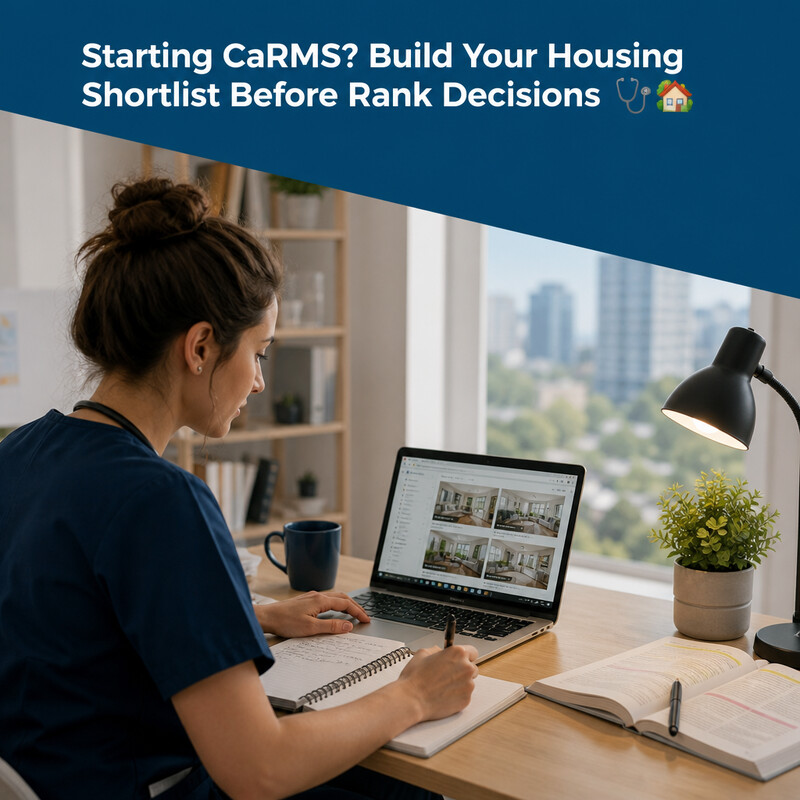
If you are beginning your CaRMS R-1 application journey, housing may feel like a problem for “after Match Day.” But where you live can affect your budget, sleep, commute, safety, parking, and day-to-day quality of life during residency. As you research programs, build a housing shortlist alongside your application list so you can compare real rental options near medical schools, hospitals, clinics, and distributed training sites.
MedsHousing.com is designed for medical learners and health professionals looking for short-term and long-term rentals near hospitals, medical schools, and clinical sites. This matters during CaRMS because your potential destinations may include large academic centres, regional campuses, community hospitals, and rural placements.
Previous MedsHousing guidance recommends preparing early, identifying your move-in day, considering program start dates, and doing commute “dry runs” when possible; it also reminds learners to consider both short-term and long-term housing options if they are unsure about neighbourhoods and travel times .
Why housing belongs in your CaRMS decision-making
Residency is demanding. A rental that looks affordable on paper may become expensive if it adds long winter commutes, paid parking, unreliable transit, or extra storage costs. A slightly higher rent closer to the hospital may be worth it if it saves you time after call, reduces rideshare costs, or lets you avoid buying a car.
When comparing CaRMS programs, add a housing column to your spreadsheet. Beside each program, note the likely training sites, distance between sites, average commute options, estimated rent range, parking availability, and whether short-term rentals are available if you want to arrive before committing to a full lease.
Create a housing shortlist for every program you apply to
Before interviews and ranking, choose two or three neighbourhoods for each city or training site. Your list does not have to be perfect yet. The goal is to understand your options before you are under time pressure.
For each program, research:
- Distance to the main hospital, medical school, clinic, and likely rotation sites.
- Transit routes and whether service runs early mornings, late evenings, weekends, and holidays.
- Driving time during rush hour, winter weather, and post-call periods.
- Parking cost at home and at the hospital.
- Whether indoor parking is available if you are moving to a snowy city.
- Bike lanes, secure bike storage, and shower facilities at work if you plan to cycle.
- Walkability to groceries, pharmacy, gym, daycare, coffee, and basic services.
- Availability of furnished rentals, especially for short-term electives, rotations, or a trial period before signing a longer lease.
Build a realistic resident budget
Your housing budget should include more than rent. MedsHousing has previously highlighted the 50/30/20 budgeting concept and encourages learners to think about necessities such as rent, utilities, food, car payments, phone bills, and other recurring costs . For CaRMS planning, adapt that idea to residency life: long hours, variable rotations, winter travel, and frequent schedule changes can all affect your monthly costs.
Include these costs in your estimate:
- Monthly rent.
- Utilities, heat, hydro, water, and internet.
- Tenant insurance.
- Laundry costs if there is no in-unit laundry.
- Parking at home and at clinical sites.
- Transit pass, gas, car insurance, winter tires, and maintenance.
- Moving costs, storage, cleaning, and first-month setup items.
- Furniture and kitchen supplies if the unit is unfurnished.
- Pet fees or pet rent if applicable.
- Emergency fund for unexpected rotation or site changes.
Tip: compare the “true monthly cost” of each rental. A $1,900 apartment with heat, internet, laundry, and parking included may be cheaper than a $1,650 apartment once add-ons are included.
Commute time is wellness time
During residency, 20 minutes can matter. A commute that seems manageable during an interview week may feel very different after overnight call, in February snow, or when you are rotating between multiple hospitals.
Test the commute before you rank
- Map the route from the rental area to the main hospital at 6:00 a.m., 7:30 a.m., and 5:30 p.m.
- Check public transit frequency before 6:00 a.m. and after 11:00 p.m.
- Look at weekend and holiday schedules.
- Search the route in winter conditions if the city is known for snow or ice.
- Ask whether residents commonly drive, walk, bike, or take transit.
- Check if you may rotate at more than one site and whether those sites are accessible from the same neighbourhood.
A good CaRMS housing strategy is not only “closest to the hospital.” It is “reliable access to the places I will actually train.”
Snow, winter, and parking: do not leave them out ❄️
For many Canadian residency locations, winter logistics are part of housing. Indoor parking, covered parking, or reliable snow removal can be the difference between arriving on time and digging out your car before a 5:45 a.m. shift.
Ask these winter questions:
- Is parking indoor, outdoor, assigned, or street-only?
- If street parking is required, are there winter parking bans?
- Who clears snow from driveways, sidewalks, and stairs?
- Is the building entrance safe and well-lit during icy months?
- Is there space for winter tires, boots, coats, and sports gear?
- Is transit nearby enough that you can avoid driving during storms?
If you are applying to programs in cities with heavy snow, indoor parking may be a high-value amenity rather than a luxury.
Bike storage, transit, and car-free living 🚲
Some residents can live comfortably without a car, especially in dense urban centres. Others may need a vehicle for call, off-site rotations, community clinics, or rural placements. Before ranking a program, look at whether car-free living is realistic.
If you bike, ask about secure indoor bike storage, elevator access, bike rooms, theft history, and whether winter cycling is realistic. MedsHousing guidance encourages renters to create a list of need-to-have, want-to-have, and nice-to-have features, including parking, natural light, transit access, kitchen size, office space, laundry, and bike storage .
Short-term housing can reduce pressure
If you match in a city you do not know well, a short-term furnished rental can be a smart bridge. It lets you arrive, learn the neighbourhoods, test your commute, meet co-residents, and then sign a longer lease with more confidence.
This can be especially helpful if you are moving across the country, coordinating licensing and onboarding, or unsure whether you want to live near the hospital, downtown, near family, or closer to a partner's workplace.
What to ask landlords before Match Day
You may not be ready to sign a lease before Match Day, but you can still gather information. Save listings, ask questions, and identify responsive landlords who understand medical training schedules.
Useful questions include:
- Is the unit available for the expected residency start period?
- Would the landlord consider a flexible start date?
- Is the rental furnished or unfurnished?
- Are utilities and internet included?
- Is parking included, and is it indoor or outdoor?
- Is there secure bike storage?
- How long does it take to reach the hospital by walking, transit, bike, and car?
- Is the unit suitable for someone doing shift work or call?
- Is there in-unit laundry?
- Are pets allowed?
A simple CaRMS housing checklist
- Make a list of every city and training site where you are applying.
- Search MedsHousing.com for rentals near each medical school, hospital, or clinic.
- Save short-term and long-term options.
- Calculate true monthly cost, not just rent.
- Compare commute times during early morning, evening, weekend, and winter conditions.
- Rank amenities as need-to-have, want-to-have, and nice-to-have.
- Ask about indoor parking, snow removal, bike storage, laundry, and utilities.
- After interviews, update your housing shortlist before final rank decisions.
- After Match Day, contact saved listings quickly and confirm availability.
- If unsure, consider a short-term furnished rental before signing a long lease.
Final thought
Your CaRMS rank list is about training, mentorship, specialty fit, and future career goals. But housing is part of the lived experience of residency. A safe, practical, affordable home near the places you train can protect your time, budget, and wellbeing.
As you start CaRMS, start your housing research too. Future you, especially post-call in a snowstorm, will be grateful. 🩺🏠
Source: CaRMS R-1 Main Residency Match applicant timeline: https://www.carms.ca/match/r-1-main-residency-match/applicant/r-1-match-timeline/